Thursday, 29 October 2015

44th (East Essex) Foot

Another regiment finished. Years ago I started out trying to do a company in 1:1, this then grew into doing a whole battalion. Now, I'm trying to finish Pack's Brigade - 3 Scottish regiments and the 44th.
Despite being one of the smallest units in the Allied line in 1815 (487 men, reduced to about half that number at Quatre Bras) this has taken me ages to finish - real life gets in the way too often.


The 2nd Battalion of the 44th had arrived in the Peninsula in 1810 and was present at Fuentes D'Onor, Badajoz and Salamanca. However, following the retreat from Burgos the Battalion was so depleted that it was returned to England.  In 1814 disaster befell the battalion at Bergen-op Zoom where, a very confused attack led to heavy casualties and 11 Serjeants, 3 drummers and 205 rank and file being captured. They were quickly released in the peace that followed soon after, and 117 of these survivors  were present at Waterloo.


The Regiment was predominately Irish – from the data available the ratio was roughly 60/40% Irish/English – the Irishmen coming almost entirely from the south, in particular from Tipperary, Cork, and Dublin.


The Battalion was disbanded on 24th January 1816. Those men not eligible for discharge were transferred to the 1st Battalion


Private Thomas Brooks (at the corner of the square above) was wounded in five places and lost an arm.  From Crealy, Worcestershire, he had enlisted in 1812 and was only 21 years old in 1815.  He was discharged in April the following year. In total 10 men of the 44th suffered amputation after Waterloo.
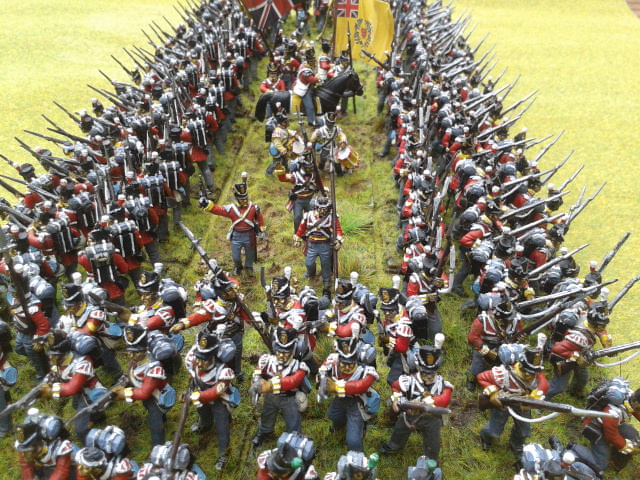


With Hamerton wounded, Major O’Malley (seen above mounted) commanded the battalion at Waterloo. From Castlebar, Mayo, he joined the army after serving as a Volunteer in the militia during the rebellion in Ireland.  He later commanded the 88th Foot (Connaught Rangers) and died a Major-General in 1843.


Men of the Grenadier Company. The average length of service already served by Privates in this company was seven years. Privates Hearle and Connolly were the oldest hands in the ranks, both having enlisted in 1799. Seen above in the right-centre of the pic is Serjeant Forbes Lyster who carried old wounds of old campaigns.  Aged 28 at Waterloo, he had been wounded in both legs and his shoulder three years earlier at the storming of Badajoz. 


Men of Number 7 Company who suffered the heaviest casualties of any company in the 44th, losing 18 men from a starting strength of 41 men (41%).

So what's next? Maybe some more Light Dragoons? Maybe some Rifles? Or maybe press on and finish Pack's brigade properly but that might mean...more tartan!!!...NOOOO!!!

Monday, 28 September 2015

Making Belgians

I'm not talking about Mr & Mrs Tintin, but rather using up some spare bits and bobs to make Belgian line infantry, and some Belgian heavy cavalry.
The line infantry is simple enough - British bodies and shakos with French arms and packs.

 I took a soldering iron to the lace above their waists, although, to be honest, the result is probably no better than just removing it with a sharp knife.

If anyone reading this has any spare French marching arms, please get in touch and I can buy from you, or swap for any plastic parts you're looking for.

Next up are the 2nd Carabineers. As I understand it, the 2nd Carabineers were Belgian and wore helmets while the 1st and 3rd Regiments were dutch and wore bicornes. To make these I used French dragoons with French Carabineer heads. They wore blankets (or greatcoats?) rolled over their shoulders so I made these using green stuff which turned out to be quite easy.

Belgian helmets were slightly different to these French ones in that they had a lion's head moulded to the front, but I will have to do my best to replicate this with the paintbrush.
 

 Maybe one day I can make some Dutch Carabineers using some of the hundreds of spare bicorne heads I have!


Each box of Perry French dragoons has only 3 elite figures with epaulettes so I bolstered these by adding epaulettes to figures, simply cutting a square into the shoulder and then adding an epaulette from a spare French flank infantry arm. I don't think this surgery will be noticable once they are all painted.

I really enjoyed making these conversions, they were a welcome distraction from the mass of 92nd Highlanders which I'm working to complete. More on that to follow.

Friday, 11 September 2015

92nd Foot (Gordon Highlanders) - reinforcements

Back to the project - finished some reinforcements to bolster the ranks of the 92nd, which are now just about complete.
I enjoyed doing this little lot despite highlanders taking so long. I've come to realise that as long as I keep doing different things, e.g. varying all the redcoats with blue jacket cavalry, Greenjacket rifles, artillery etc, I can get a lot more done, rather than facing the psychological mountain of a whole regiment of the same uniform at 1:1
Huge thanks to Steve at Victrix who sent me a huge box of "spare" Highlander sprues to help out on my project, a very kind gesture which, on my limited budget, was enormously appreciated. So, apart from a few Front Rank, these are nearly all Victrix beauties. Of the three regiments in Highland uniform at Waterloo I've put the Black Watch in square, the Camerons in firing line, and the Gordon's charging (or maybe running away from D'Erlon's columns - you decide!)

 With the regiment suffering so heavily at Quatre Bras, these 60 or so men represent more like two companies, rather than one. I had to use a panorama shot to try to get them all in one shot, hence a bit blurred!


The 92nd Foot was a regiment of enormous experience. Many of the men in the ranks in 1815 had been soldiering since the previous century.  Several had seen action as long ago as 1801 when they fought in Egypt and even more had campaigned with Sir John Moore in the Coruna campaign and then returned to the Peninsula for the rest of that war. During this time the battalion fought at Fuentes D'Onor, Vitoria, Pyrenees, Nivelle, Nive, Orthes and Toulouse.


 The running officer (left) is Lieutenant Andrew Will, a Peninsula veteran, who was one of the few officers of the 92nd to survive Quatre Bras and Waterloo unwounded. Indirectly, however, this luck led to his posting, in 1819, to Jamaica where, like so many in the regiment, he died of yellow fever. The figure is a conversion, adding a Highland officer's body to the running legs from a Victrix. British Line Infantry box.


The men of the 92nd were nearly entirely Scottish, predominately from Aberdeenshire and Invernesshire, and Gaelic was often spoken instead of English. By Waterloo these seasoned veterans were growing long in the tooth -  the average age in Number 1 Company for example was 36 -  and a large proportion of those who survived the Napoleonic wars were discharged between 1815 and 1819.


In the centre of this pic is Captain Archibald Ferrier who had survived Quatre Bras but is seen here falling wounded at Waterloo. He was promoted to Major in 1818. Like Lieutenant Will above, Ferrier also died of yellow fever in Jamaica in 1819.


If I have time, I'll take some pics with these 92nd mixed in with the Scots Greys,"Scotland Forever" - though probably not with any hanging on to the stirrups, as has been famously claimed.