Sunday, 25 November 2012

28th Foot (North Gloucestershire)

Very nice to have a little break after all those highlanders. I hate painting but love playing around with all the creative options the new 28mm plastics provide. Here are some casualty figs for the 28th Foot. They were a kind of reward to myself for finishing the Camerons.


I'm going to carry on with the whole of Kempt's Brigade - they'll all be in firing line, except for those companies of the 95th which were skirmishing down by the sandpit.


Oh and the light company will be out skirmishing.


I'll be posting more as they come along. At the moment it's such a joy to have no more tartan!

Sunday, 11 November 2012

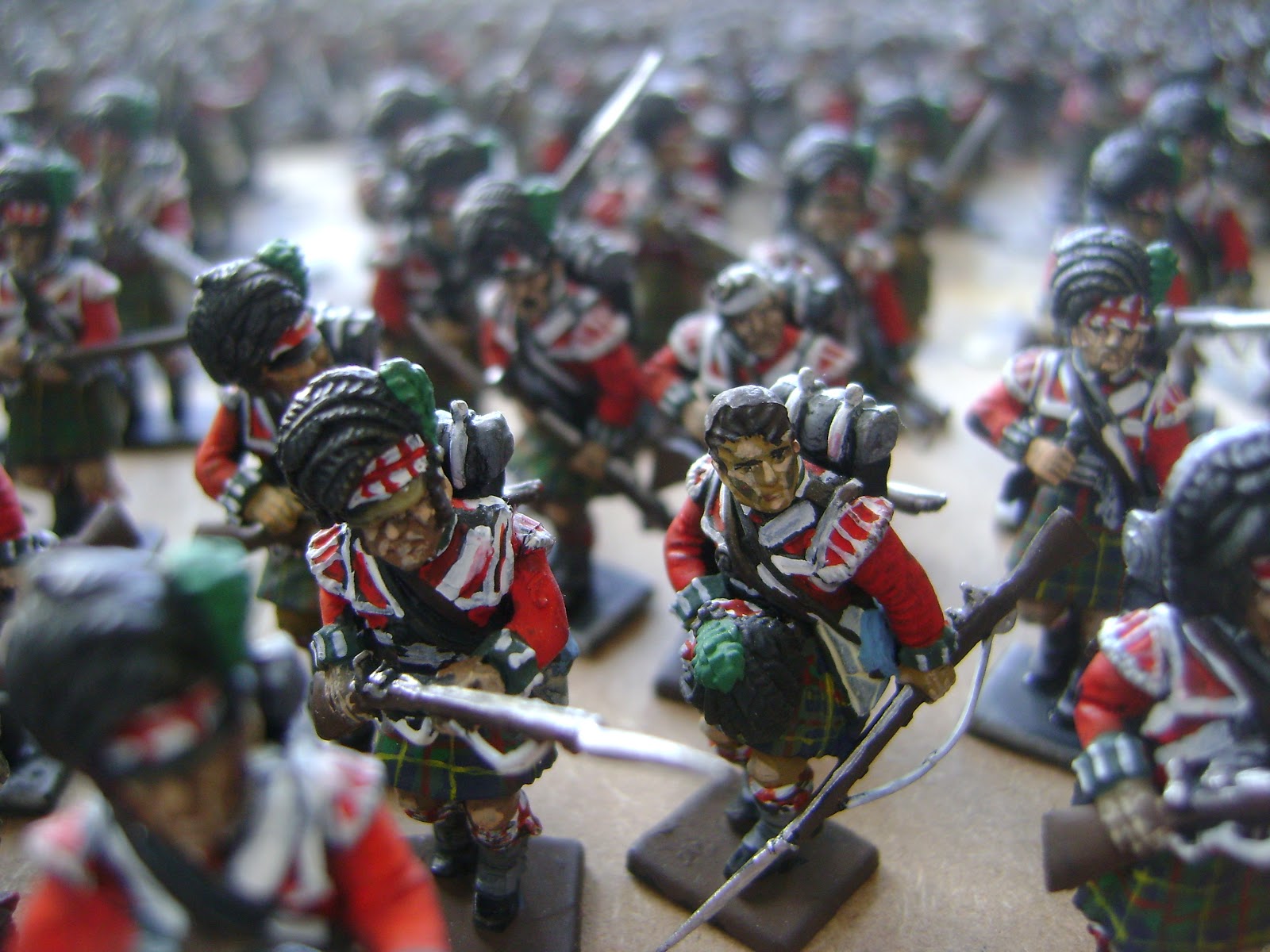
79th Camerons - basing part 1

I was probably 10 years old the last time I laid an army of toy soldiers on the floor - I thought I might be able to take some pics of the whole 79th battalion in firing line but discovered my flat is too small!


The whole line is about 12 foot long and the best I could do was get 8 of the 10 companies running along the mantlepiece and a shelf.


This still left a couple of companies doubled up behind which was a pity, I'll have to find a better location to take pics someday.


Grenadier company


Some of the light company, badly shot up two days earlier at Quatre Bras.


The Battalion's centre company drummers, regulations stated that they should form up behind No.7 Company.


Still missing a few NCOs to be added to the smaller bases later, along with some debris etc


Command base - still very much in progess. Included are colour serjeants McQueen and Manuel, QMS James Hay, Serjeant Major Masterton McIntosh, Piper Kenneth McKay


Some bawdy fellows from No.4 (Lieutenant Donald McPhee's) Company

The next steps will be to finish the mountain of "last touches" for the painting - mostly the rear rank which I haven't glued on yet. I also need to sort out the flags.Then there's the actually basing with grass tufts etc. I'm not very good at it but it's the part of the process I probably enjoy most as it brings everything to life. The last step will be to print out the names of the men to stick under each base.

Thursday, 25 October 2012

Sunday, 14 October 2012

79th Cameron update 14th October

I've been pressing on with the 79th and have got to the stage where I've been checking the numbers I've got versus against those actually present - for example the numbers of officers, serjeants, and drummers in each company. I found, for example, that I'm short of several serjeants in the grenadier company so have put together a couple more and undercoated them. Not sure I can face painting any more tartan for a while though!

 some centre company men


 Grenadier Company
  
 
 Light Company
                 
  Officers
  
 
These are the bases I used for my hussars - 12cm x 16cm. 


I like the size and I'm going to get some more, cut lengthways, to use for my 79th. Each section will therefore be 6cm x 16cm and hold 2 files - 16 men in all. 

For those units which I'm depicting in square there is enough space for 3 ranks.


For light companies out skirmishing I might use a whole 12cm x 16cm for just 16 men.

Wednesday, 3 October 2012

ADCs

I am obviously biased but it seems to me that there is something of a conspiracy against the British army during the Napoleonic era. Amassing a British army is often sneered at, especially 1815. "Oh dear no, I only collect Austrians 1801-1803, everything else is so passé".  A result of this is what I believe to be a commonly held theory that the British have been done to death by all manufacturers while other countries have missed out. However, while everyone produces the holy trinity of Wellinton, a Picton (oooh top hat), and Uxbridge, that's pretty much where it ends. The Perrys then turned out Kempt, Halkett, and Pack and a lovely 3 figs they are too but when you compare this to the extent of the staff etc from other countries I am left feeling rather short-changed:
Russian - I look at that new Perry high command set and weep.
Prussian - oh my god, Calpe do 8 command sets alone!
French - more than 100 command figures available? There must be at least 20 colonels, there are even valets carrying a tray of drinks for god's sake. 
Even the Dutch have a nice staff set with 5 ADCs etc (plus the Duke of Orange + staff).

At present, as well as the absence of ADCs and other staff, nobody even makes the key British commanders at Waterloo - Ponsonby, Grant, Adam, Vandeleur etc

And don't even get me started on light infantry - what NONE firing or skirmishing, just 1 pack by Perrys "running at trail"? Have you SEEN the wondrous array of French light infantry available? Did the Light Division not do much in the Napoleonic Wars then?

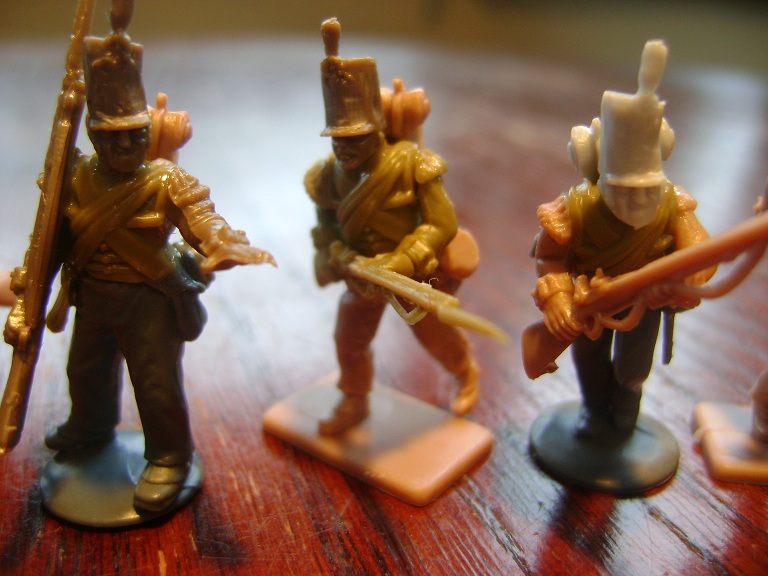
So, if nobody makes ADCs what do you do? Well luckily Perry and Victrix plastics mean you can make your own. Here's what I made yesterday during a break from the Camerons:


Here we have Ensign Hon. Edward Stopford - ADC to Byng of the 2nd Guards Brigade. He was 21 years old at Waterloo. Looks like he's on his way either to or from Hougoumont - maybe something about the spread of that fire.


I picked up some ACW figs on the cheap off ebay with these conversions in mind. So this a hybrid of Perry ACW horse and legs, Perry tunic tails, sword, hat, Victrix officer body and arms. Still a bit ragged around the edges but should clean up ok when painted.


 Lieutenant Hon.George Cathcart - ADC to Wellington, and as such wears 2 epaullettes.


On the left is Pack's ADC - Major Edmund L'Estrange - he wears the uniform of his regiment, the 71st Highland Light Infantry (sash worn across body). His leg was shattered by a round shot and he died shortly after amputation.
On the right is Lieutenant Thomas Baynes (39th Foot) who served as ADC to Lambert.

These two still need horses - so if anyone reading this has any spare horses, plastic or metal, preferably standing...!


Unrelated but I thought I'd put up a pic of this other conversion - Captain John Garland of the 73rd. Stripped of his Highland uniform he retains his Highland sword.


Wounded about 7 o'clock, so badly wounded that an obituary was printed in Gentleman's Magazine, but lived to become Lieutenant-Colonel. 
"Captain Garland, on whom the command of the Regiment had now devolved, invited us from the shelter of the bank to follow him in an attack on about three thousand of the French infantry.  About a dozen of us responded to the call; and such was the destruction of the fire to which we were opposed, that we had not advanced more than six or seven paces before every one of the party, except me and my brother, was either killed or wounded. We carried our Captain back to the shelter of the bank, where we found our first Major [Kelly], who had not been with us during the day, having been attached to the staff.  He directed the Captain to be taken to the rear, and then caused us to be mustered....Captain Garland was a brave officer and had seen a great deal of active service....he went through the whole of the Peninsular campaigns and...had hitherto escaped unhurt.  Now however, he was most severely wounded, the thigh bone having been fractured by a musket ball.  Amputation was pronounced to be indespensable; but, objecting to the loss of a lim, by the most assiduous and eminent skill, in a twelvemonth he was sufficiently recovered to be removed, he being the last wounded officer who left Brussels.  His case was attended with great surgical difficulties, four inches of the fractured bone having been removed, and a union effected of the two extremities." (Morris) 

Garland was attended throughout this year of convalescence by Private William Cox (also wounded) of No.4 Company, who then was in his service at Dorchester for the next 17 years.

Born 1784, son of John and Catherine Garland of Dorchester he served in the Dorset Militia before being commisioned as Ensign in 44th Foot.  He was promoted to Lieutenant in the 27th Foot in 1806 and transferred to the 30th Foot in 1807.  With the 30th he served in the Peninsula at the sieges of Tarifa and Cadiz and was made adjutant in 1811. He then served at Fuentes d'Onor, Salamanca, Badajoz, and Burgos and as a reward for his distinguished service was given a company in the 73rd.  He married a widow, Susan Martin at St Mary's Church Marylebone 1842 and lived to receive his MGS with three clasps. He died at Lille, France in 1851. 

Sunday, 30 September 2012

79th Camerons - update Sep 30th

Not much to report - just slowly pressing on with the Camerons:

Officers


 Serjeants

Drums


the rest of the buggers


Monday, 24 September 2012

71st Highland Light Infantry - serjeants

I spent the weekend doing more work on the Camerons - just waterbottles and haversacks but they're starting to look pretty good now.  By Sunday evening I'd had enough of painting and rewarded myself with my favourite part of the hobby - fiddling about with bits a knife, glue and bits of plastic to make new modified figs.
A problem that I've been wondering about is that nobody makes serjeants for the peculiar 71st Foot. If you're not familiar with the unique uniform of the 71st, I'll quickly outline the basics: they were a light infantry regiment so they wore the stovepipe shako and winged epaullettes, the same as the other light regiments at Waterloo - the 51st and 52nd.

The 71st, however, being a "highland" regiment (actually most men were from Glasgow or Edinburgh) retained some distinguishing features - the most noticable being a diced highland band around the shako. Incidentally, I'm not sure how I'm going to paint hundreds of these bands,  I think it might be beyond me and have been talking to Flags of War about possibly doing transfers. He says it would be possible so that might be a possible solution. For the shako I scrape off the plate of Victrix peninsular heads - I suppose at some point I will have to find a way of adding hundreds of tiny bugle badges in their place. Some experts assert that the 71st shako was actually a blue wool bonnet but I'm sticking to the conventional stovepipe look.


Anyway, the other big difference is that none of the 28mm manufacturers cater for the other quirk of the 71st, that serjeant sashes were worn across the shoulder, like Highland serjeants, and not around the waist as was regulation. So last night I set to work and grafted some spare Victrix highland serjeant torsos onto Victrix and Perry line legs. I then added the arms and heads etc


Highland sash - across left shoulder.


I still need to do some filing and fill in a few gaps but in general  I'm pretty happy with them. As well as having some nice new serjeants to urge on the men of Glasgow there is no wastage - the lower half of the highland serjeants are grafted back onto the torsos of the other rank figures - a shameful loss of stripes but they can get back into line and plug some of the gaps!