Saturday, 17 August 2013

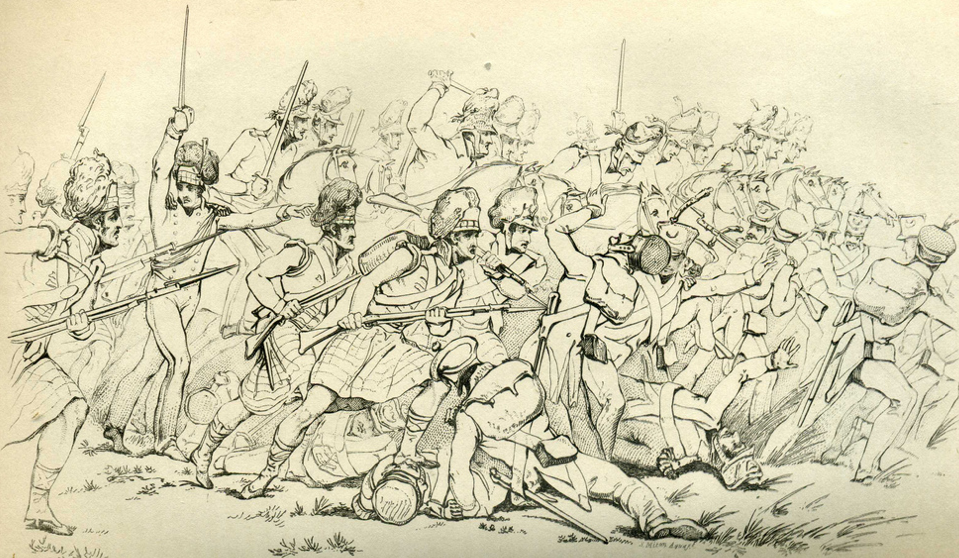
"A" Squadron - Scots Greys - finished

Here at last are the 106 men of A squadron of the Scots Greys - comprised of No.1 Troop (Bernard's) and No.2 Troop (Payne's)

These have taken me months, I lost nearly five weeks with holiday abroad and visitors staying, but I've enjoyed doing them - they're great figures from Foundry and Perrys, and a joy to paint.


Captain Charles Bernard, commanding the right squadron, was the elder brother of Cornet Bernard of the King’s Dragoon Guards. Both were killed at Waterloo.  Their mother died upon learning of her sons’ deaths. Another brother, Francis, had already died on service in Portugal. Charles was born in 1790 and had previously served in the 38th (1st Staffordshire) Foot and the King’s Dragoon Guards. He had seen previous service in Germany and had been wounded whilst serving in the Peninsula. 


No.2 Troop was commanded by Captain Edward Payne. He quit the army a few months after Waterloo. He is reputed to have returned from Waterloo with the coat of Colonel James Hamilton (the Greys commander, killed at Waterloo) and married his widow.

Here are Lieutenants James Carruthers and Thomas Trotter. Both were killed at Waterloo. Trotter was shot through the heart by a French officer in the first charge. Carruthers fell near Brigade commander Ponsonby who was also killed.
Between them are Corporal Hugh Wylie, who was promoted to Serjeant after the battle,  Private Will Taylor from Suffolk, still listed as wounded in December 1815, and Trumpeter Henry Stevenson.

 
 The Greys were about 76% Scottish (mostly from Glasgow) and 23% English. Over 20% of the regiment were killed - the worst casualty rate of any British cavalry unit at Waterloo. The average age was 30; Serjeant Will Porteous, above, was 39 and was discharged in 1816 having received 8 lance wounds at Waterloo.


No.2 Troop (above) had a nominal strength of 77 but perhaps 15 or more of these would have been at the rear with baggage etc. The Troop lost 22 men in the battle. Just out of shot in the bottom right is Trumpeter Hutchinson who was killed in the charge. According to one account it was Hutchinson who first took the French Eagle, not Ewart, "The flag in question, and the largest of the two hanging in Chelsea Hospital, was taken in the first instance, in the first charge, by a trumpeter named Hutchinson, who, with his horse, was immediately killed;whereupon Ewart, then a corporal, seized the colour and having fought hard for it, kept it."


Troop Serjeant Major William Robertson was born in Renfrew and joined the Royal Fifeshire Yeomanry in 1794 aged 16 before joining the Greys. He served over 11 years as an NCO and in 1809 was recommended for an Ensigncy by General David Dundas. In 1821 he was discharged from the Greys after injuring his knee after jumping from a wall. The officer signing his discharge papers wrote his conduct had been, "most excellent in every respect. I am not aware of his having any faults… Behaved most gallantly at Waterloo."


Sunday, 7 July 2013

Scots Greys (2) update

Still working at these - I'm quite pleased with the gauntlets and plumes now that they've been painted up. I got a few late reinforcements off ebay and they've been added.


This might be the last weekend I get to do any painting for a while so thought I had better post something!  P.S. If anyone reading this has any "spare" heavy cavalry (dragoons, life guards etc.) by Front Rank, Perrys or Foundry - I'd be very interested in paying you for them. They will be very welcome!


Sunday, 16 June 2013

Happy Quatre Bras day!

Little to report but I thought, it being 16th June, I should post something.
Here is the beginning of the next project, 2 squadrons of the Scots Greys (about 120 men)
They are a mix of Foundry and Perry figs and I will probably divide them up into one squadron each. I'm very far from rich so these have been accumulated through numerous little ebay bargains, hunted down over the last 12 years or so. The other four squadrons will have to wait for some distant date in the future when, hopefully, someone starts making 28mm British heavy cavalry in plastic!


The new Perry figs are lovely sculpts but I can't help wondering why they were cast without the heavy white gauntlets which they wore. If you were about to engage in combat, probably with another big guy chopping at you with a big, sharp sword which would you go for? a) bare hands   or b) massive, thick leather gauntlets
So yesterday I spent about 4 hours adding my own milliput gauntlets to about 60 figs. They're a bit rough around the edges but I think they will look good when all painted up.
I'm also in the process of adding plumes to all the figs - I strongly believe that the Greys removed their oilskin covers and wore their plumes at Waterloo, and could ramble on at length, probably tediously, about all the primary evidence which supports this (not least being Corporal Dixon who describes having his plume shot off in the first charge!)

Whatever, there's nothing I can do about the oilskin covers adorning all of these figs but I can add a plume (cleverly protruding through an aperture in the cover...I have decided!)


.

Saturday, 8 June 2013

Rifles - finished

Here is No.1 (Miller's) Company 2nd Battalion 95th regiment as they pour volleys into the Chasseurs a Pied of the Imperial Guard in Napoleon's final attack. Those names in pink were wounded, those in red were killed or died of wounds.

(front row) Corporal Dan Killing, Private Sam Doggett, Sam Hardy, Lieutenant John Fry, Privates Alex Smith, George Columbine,  Daniel Gardiner, James Giff, Corporal George Perry, Captain George Miller)
(back row) Privates William Halfpenny, Dennis Duff, Richard Jordan, Serjeant John Rutledge, Privates Richard Underhill, William Wood, George Turnbull, William Smith 1st, Henry Pollard, James King, John Francis)

(front row) Privates William Plunkett, Thomas Smith, William Willington, Luke Benton, Sam Cheetham, John Mitchell, John Pearce, William Aldridge, John Kinch, James Saunders
(back row) Corporal Willam Day, Privates Thomas Johnson, Thomas Jones 1st, Charles Dullea, John Himbury, Joseph Kemp, Joseph Luscombe, William Jones 1st, John Perry, Zachariah Giles, Patrick DignamJohn Daniels, James Spencer)

in the rear are Bugler Charles Perry, Serjeant James Stanley and Lieutenant & Adjutant Thomas Lawrence Smith.

(front row) Private Benjamin Child, Corporal Michael Nangle, Privates James Bennett, Joseph Elliot,  Thomas Conquest, Howel Bevon, John Hart 2nd, Cornelius O'Connor, Lt Thomas Cochrane, Privates Patrick Jelly, John Lewis, David Hague)
(back row) Corporal James McChristol, Privates William Wells, William Brockenborough, George Hopkins, Thomas Lawrenow, Corporal John Burrows, Privates Edward Marriot, William Hurst, Thomas Knight, Peter Street, William Suthers, Richard Voss, William Stamp)

 (front row) Corporal John Cocker, Private George O'Neil, Robert Fulton, William Edwards, William Greyson, Thomas Bushmill, Thomas Jordan, Owen Sullivan
(back row) Privates Thomas Tiffily, John Wyndham,  Richard Spatfield, James Sell, Nathanial Wood, John Sullivan, Corporal Alexander Watt

 The 2nd battalion ranks were comprised of 69% English, 19% Irish, 8% Scottish, and 4% Welsh.
Miller's company suffered 29 casualties - Privates John Daniels, John Francis, and Robert Fulton were killed in action, Samuel Doggett died of his wounds.


When Lt Colonel Amos Norcott had been wounded at 5pm, command had fallen to Lt-Colonel George Wilkins. who then "...whilst talking to the Duke in square prior to the final attack (of the Imperial Guard)  "both himself and horse were felled to the ground by the enemies [sic] artillery."

Thus Adjutant Smith may well have been the only mounted officer by the end of the evening (assuming his horse had not also been a casualty!)
Serjeant James Stanley, wounded in the final attack, had served in the regiment since 1805. He was from Sheepshead in Leicestershire, and aged 33 at Waterloo.

Saturday, 25 May 2013

95th Rifles - work in progress - Part 3

Nearly finished now - just need to do plumes (which I'm going to do in a much lighter green) and some other details such as the canteen straps.
I love basing  figs and am constantly fighting an urge to base them before they are properly finished. Also, my current lack of space means that a unit of based figs takes up a lot more room than those which are still loose - so I'm hesitating. It makes more sense to just put these away and move on to the next unit but...I just bought a load of grass tufts! We'll have to see.


I put thirty canteen and backpack decals on these guys. I'm not sure what I think of the results, they are great decals but at this scale you are either a) too far away to even see them or b) so close up that you can see very clearly every wrinkle, crease, shine etc. i.e. the decal is very obvious.  I might just leave the rest - again not sure.


I've had a lot of fun with this unit - about half are Foundry, Front Rank and Perry metals, but the rest are made up of the bodies of Perry plastic riflemen, grafted onto all manner of Perry and Victrix legs with a variety of converted heads. The officer here, for example, is a Victrix head and officer body with a Perry hussar pelisse.


Sunday, 19 May 2013

95th Rifles - work in progress Part 2

Just an update - they're coming along nicely and quite pleased so far. I asked for some help r.e. undercoating and varnish on the Steve Dean forum and received some very useful advice - I'm so used to working with plastics where the paint never chips off and needs no varnish, that all these metals were quite tricky at first (of the 65 men about 30 are metal). But now, thanks to the matt Daler Rowney varnish which I bought, things are much better. I'm very grateful for the advice, and increasingly I can see that the difference between terrible figs and beautiful figs has very little to do with an individual's skill but rather, is pretty much down to what you know.
Anyway, here are a couple more pics of Number 1 company, 2nd Battalion Rifles. Still plenty to be done but much, much quicker than all those damned redcoats!